
Towing Dispatch Answering Service: Answer Calls While You Hook Up
A towing dispatch answering service captures location, vehicle and drop-off while you are mid-hookup. What it handles, what it can't, and what it costs.
Towing Dispatch Answering Service: Answer Calls While You Hook Up
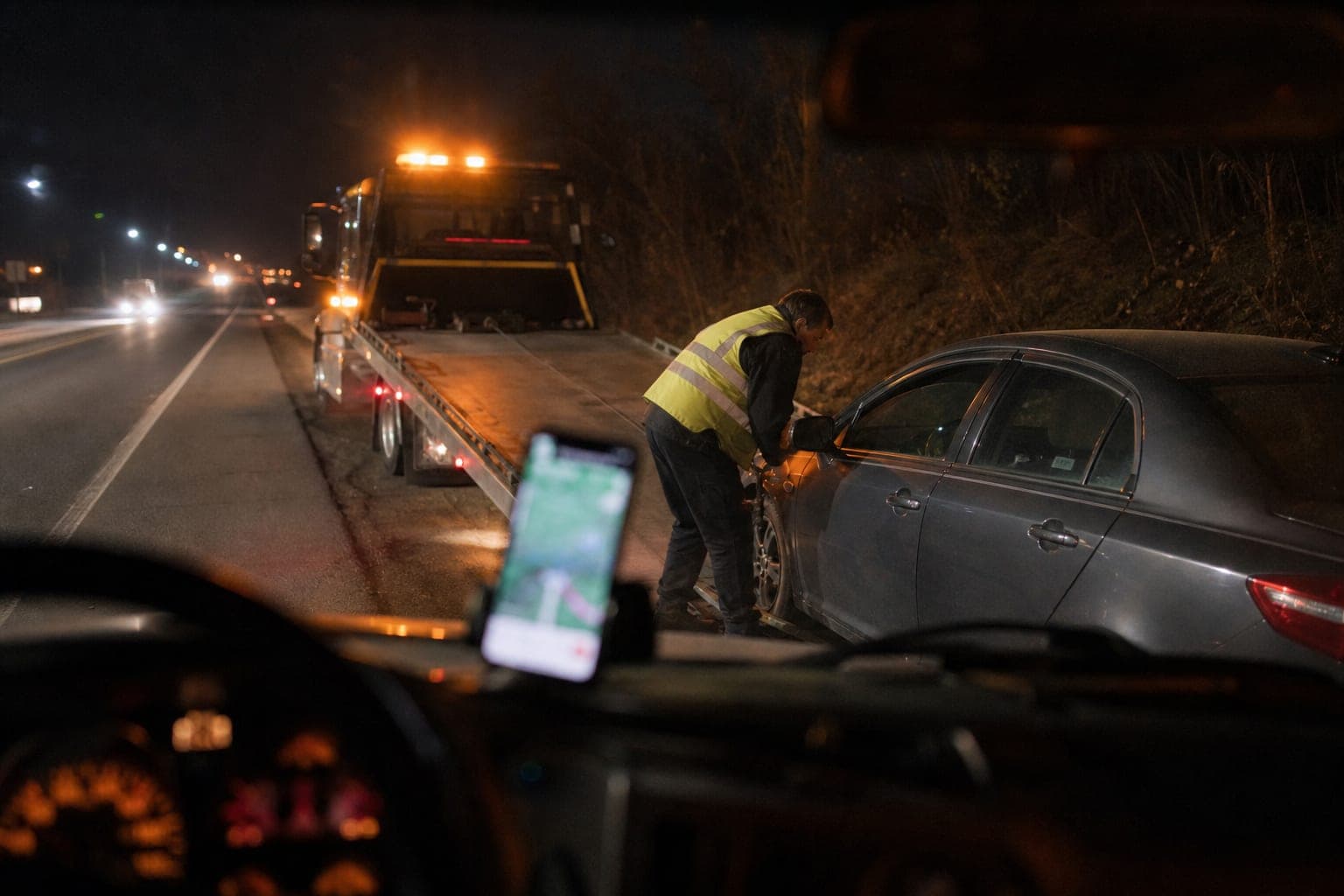
Picture a Saturday at 1:30 AM. You run a one-truck towing business with no towing dispatch answering service behind your phone, and you are on the interstate shoulder with a disabled sedan half-winched onto the flatbed. Amber lights are flashing, traffic is passing close, and both hands are busy. In the cab, your phone lights up. Then it lights up again.
The first call is a driver with a flat tire, stranded on a shoulder a few exits north. The second is a body shop owner who wants a car moved first thing in the morning. The third is someone asking when they can get their car out of your lot. You cannot answer any of them. You cannot even look at the screen without taking your eyes off the winch.
A towing dispatch answering service answers that phone for you and handles the first half of dispatch: where the car is, what it is, what is wrong, where it needs to go, and how to reach the caller. It then gets that information to you in a form you can act on the moment the car is secured. For a one-truck operator, Callbook voice plans run $79-299 a month, versus per-minute billing at many live services - the cost breakdown is below. If you want the broader overview of answering services for towing, start with our towing answering service guide and the towing industry page. This post stays on the dispatch side.
Why towing dispatch is different from other phone work
Most trades take a message and call back in an hour. Towing does not work that way.
What a towing dispatch service has to capture
The best dispatch notes are the ones you can read in ten seconds and drive to. Here is what a good call should collect, in roughly this order.
Safety first, then location
If you add a safety question to your script, Callbook can ask whether anyone is hurt and point the caller to 911. It gives no other safety advice. After that, the call needs a location good enough to find:
Callbook can check an address against your service area, which helps filter out calls you cannot take. It does not map the exact spot.
Vehicle and problem
Drop-off and who is calling
Payment questions, deferred to your policy
Callers ask whether you take cards, whether insurance or roadside coverage will pay, and what it costs. Callbook can quote the prices or ranges you configure and answer from the policy you wrote. It does not collect payment on the call. Anything outside your script becomes a note for you: "caller asked about insurance billing."
Your options in 2026
The full provider comparison is in our guide to comparing towing answering services side by side, so this section stays short and sticks to dispatch.
Live answering services and virtual receptionists work the same way for a tow line: a person answers, which suits chatty callers, and a tow truck answering service staffed by people often bills by the minute. Virtual receptionists vary; at Ruby, for example, 24/7 coverage costs extra (see Ruby). Some live services do not read your calendar or book jobs, and scheduling is sometimes a higher-tier feature, so ask. An AI answering service follows your script at any hour and texts you a summary, but it is software: it will not make judgment calls about an odd situation, and it cannot see your truck. Voicemail is free and nearly useless in towing, because a stranded driver does not leave a message; they call the next number.
| Option | What you pay (approximate) | Who answers | Dispatch question to ask |
|---|---|---|---|
| Live receptionist service (Ruby) | around $235+/mo for 50 minutes, about $4.70/min after | A person | Will the agent follow a location script, and what does 24/7 add? |
| Live service (PATLive) | around $235/mo for 75 minutes, about $2.00-$2.60/min | A person | Who covers the 1:30 AM calls, and is bilingual an add-on? |
| Callbook (AI) | $79-299/mo, $0.40/min past included minutes | AI, using your script | Does your script ask for mile marker and direction of travel? |
| Voicemail | Free | Nobody | Callers hang up, so what is captured? |
Competitor figures are approximate and drawn from our compare pages, so confirm current numbers with the provider before you sign. See PATLive for the details we have.
What Callbook can and cannot do for dispatch
Be clear about the line, because dispatch is where overpromising hurts.
It can:
It cannot:
If you have a second driver, the practical setup is simple. Callbook texts the owner and team a summary, and the forwarding number is whichever phone is on duty. Someone still has to decide which phone that is. For a rotation, see our glossary entry on the on-call rotation.
Towing dispatch answering service cost: a worked example
Scenario (illustrative numbers): a one-truck operator gets 160 calls a month that Callbook answers, averaging 2.5 minutes each. That is 160 x 2.5 = 400 minutes. For a wider look at what an AI answering service costs, see our cost guide.
Ruby is the high end. A lower per-minute service like PATLive costs less at 400 minutes, though still more than Starter, and the bill rises with every extra minute.
Your numbers will differ. The point is the shape: the base price is the same every month, while minutes past the included amount cost $0.40 each. There is no night or weekend surcharge. Live per-minute services move with every extra minute, and a busy storm night is a busy bill.
Before deciding, run your own call volume through the missed call revenue calculator, and see current plans on the pricing page.
The 1:30 AM interstate call, handled three ways
Back to the Saturday on the shoulder, with three calls in a row.
Voicemail. All three callers hear a greeting. The stranded driver calls another tow company within a minute. The body shop owner leaves a message you hear at 7 AM, by which time they have booked someone else. The lot caller leaves a message you return Monday. You finish the hookup and have three problems and no jobs.
A live service. A person answers each call. The stranded driver gets a human voice, the details come to you, and that is worth real money. The cost is the per-minute bill, and the body shop pickup may become a note you have to reschedule yourself.
An AI answering service like Callbook. Each forwarded call is answered by Callbook instead of rolling to voicemail. Test how overlapping calls behave on your line before you count on it.
1. The stranded driver gets asked for the direction of travel, nearest mile marker or exit, a landmark, the vehicle, and a callback number (plus a safety question and a pointer to 911 if you added one to your script). The caller is told the details are with you and that you will confirm timing. Callbook does not guess an ETA. It may try your phone first; since you are mid-hookup and cannot pick up, it falls back to a callback request and a text summary.
2. The body shop owner's pickup is captured: vehicle, pickup address, drop-off, and preferred time. If you have set up pickups as a bookable service, Callbook checks your calendar and books Saturday at 8:00 AM, texting the caller a confirmation. If the calendar is not open, it takes a callback request.
3. The lot caller hears your hours, your address, what to bring, and your fees as you wrote them. Anything outside the script becomes a callback note.
Three text summaries land on your phone. You finish the hookup, read them at a stop, and call the stranded driver first, as soon as the car is secured.
Common mistakes with towing phone coverage
How to choose a towing dispatch service
Ask these before you commit:
1. Can it capture highway, direction, mile marker, and landmark, not just a street address?
2. Does it text you a clean summary the moment the call ends?
3. Can it answer lot questions from a script you control?
4. Does it read a calendar so it can book scheduled pickups?
5. Can a person take a live transfer when you are free, and is there a callback path when you are not?
6. What does a busy month cost, in plain arithmetic?
If you are a one- or two-truck operator who loses calls mid-hookup, an AI answering service can cover the gap for far less than a per-minute live service, as the illustrative example above shows. If you want a person on every call, a live service is the right choice and the extra cost buys that. Some tow companies split it: AI answers overnight and weekends, and you or a dispatcher take calls during the day. If you want an answering service for tow companies set up that way, our towing answering service guide compares the providers you could use for either half.
The shoulder at 1:30 AM, one more time
Back on the interstate, you strap the last chain, check the load, and finally pull your phone out. Three summaries are waiting: the stranded driver's mile marker and tire problem, the body shop's pickup booked for 8:00 AM, and the lot caller's question answered. Some callers will still try another number while they wait, but this one has a callback promise and a real note on file. You call the driver with the flat first, with the mile marker and vehicle already in front of you.
Try Callbook free - answer the next tow call while your hands are on the winch.
Related Reading
Frequently asked questions
What does a towing dispatch answering service actually do?
It answers your tow line when you cannot, and does the first half of dispatch: location, direction of travel, vehicle, problem, drop-off, and a callback number. A good one then sends you that information fast enough to act on it. It does not drive the truck or decide who gets towed first - you still make those calls.
How much does a towing dispatch answering service cost?
Many live-agent services bill by the minute, for example about $2.00-$2.60 a minute at PATLive and about $4.70 at Ruby once you pass the included block, so a busy month adds up quickly. Callbook voice plans run $79-299 a month, starting at $79 with 250 minutes included, and minutes past that cost $0.40 each. Say a one-truck operator uses 400 minutes in a month: that is the $79 base plus 150 extra minutes at $0.40, or about $139.
Can a tow truck answering service give an ETA?
Only a careful one. Callbook can tell a caller their technician's ETA, but it does not track your truck by GPS and does not calculate drive time, only a flat buffer you set. It never promises an arrival time it has not checked, so if it has no checked answer it should say you will confirm the ETA rather than guess.
Can an answering service for tow companies answer impound and lot release questions?
Yes, if you give it the answers. You write the FAQ: lot hours, address, what a person should bring, and the fees you charge. Callbook answers from that text and takes a callback request for anything it does not cover. Release rules differ by city and by who ordered the tow, so the rules come from you.
Can an AI receptionist take payment for a tow over the phone?
No. Callbook does not collect payment on calls. It can quote the prices or ranges you configure and answer payment questions the way you wrote them, then leave the actual payment to you or your driver at the job.
Related Articles

Best Answering Service for Tree Service Companies (2026)
Compare answering services for tree service and arborist businesses. Handle storm damage calls 24/7, book estimates, and capture every lead.

Best Answering Service for Water Damage Restoration Companies (2026)
Compare water damage restoration answering services for 2026: live operators vs 24/7 AI, real pricing, and why speed to answer decides who gets the job.

Best Answering Service for Window Cleaning Companies (2026)
Compare answering services for window cleaning businesses. Handle quote requests 24/7, collect property details, and book more recurring clients.