
Call Center for Contractors: Answering Service, In-House CSR, or AI?
Call center for contractors: what a home-service call center does vs an answering service, an in-house CSR, or AI, plus costs and questions to ask.
Call Center for Contractors: Answering Service, In-House CSR, or AI?
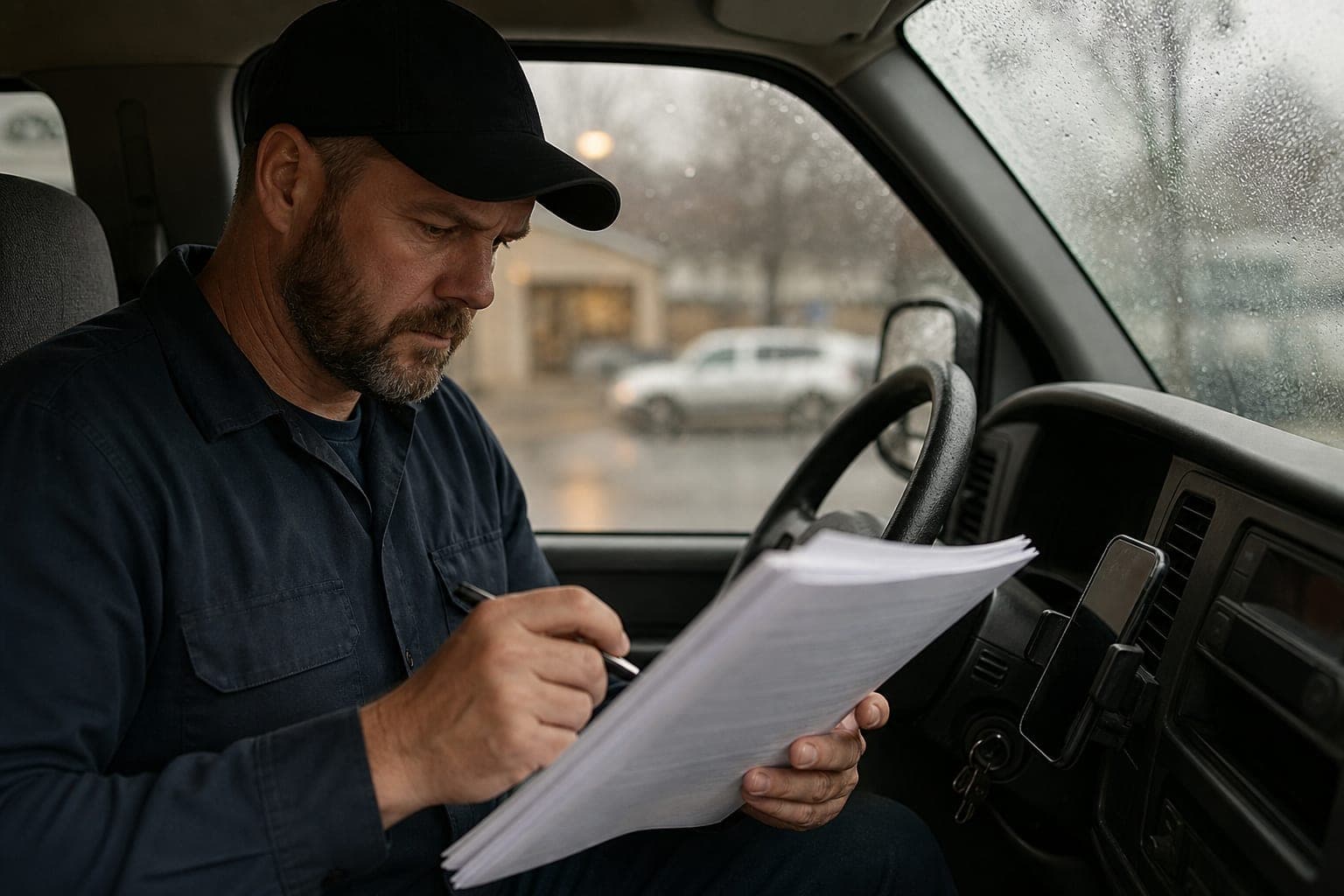
Picture the owner of a six-truck plumbing company, parked in his cab outside a job site on a rainy Tuesday afternoon, with a pen in one hand and his phone on the dashboard. A thick printed contract from a call center for contractors sits on his knee, the pitch that arrived after his in-house CSR quit two weeks ago. Since then every call to the office has gone to voicemail. The contract has a monthly minimum on page two and a training fee on page five, and he cannot tell whether either one buys him a single booked job.
His problem is one many growing contractors recognize: the phone becomes a department, but nobody owns it. Every option on the table looks like a "call center" until you read what the agents may actually do on a call.
The short answer
A call center for contractors is an outsourced team that answers your phones. For a growing company, the real choice is between four things: a home service call center, a message-taking answering service, an in-house CSR, and an AI receptionist. They differ on three points: who picks up, what they can do on the call (take a message or book the job), and how the bill grows when you get busy.
If you need trained people who book jobs and your volume is steady, a call center can pay for itself. If you mostly need every call answered and booked without a monthly minimum, an AI receptionist for contractors is worth pricing first. One option is a hybrid: AI answers first and the office handles the complex calls.
What a call center for contractors actually does (home service call center explained)
A home service call center is a team of agents, often working shifts, who answer calls for several contractors at once. When the work is done well, the agents learn your trade, ask for the address, check it against your service area, and take down the problem in enough detail for a dispatcher to act on. Some are trained to book jobs into your schedule and some stop at taking a message.
Three things separate a good one from a weak one:
The contract is where those answers hide. Some call centers charge a training fee and a monthly minimum, so ask whether the first month costs more than the tenth.
Answering service vs call center: the real difference
People search "answering service vs call center" because the two terms overlap. In practice, an answering service is the lighter product. Agents answer as your business, take a message, and send it to you, or transfer an urgent call to your phone. Our guide to what a live answering service is walks through that model.
A call center is often bigger and more customizable. It may handle longer scripts, overflow from your own staff, dispatch support, or customer service beyond the first call. It is also more likely to be quote-based with a monthly minimum.
The names are not regulated, so a "call center" can be a message-taking service with a bigger logo. Do not buy on the name. Buy on the call flow you can listen to. If you are weighing a human receptionist against one of these, virtual receptionist vs answering service covers that split.
Four ways to cover the phone, side by side
| In-house CSR | Answering service | Home service call center | AI receptionist | |
|---|---|---|---|---|
| Who answers | Your employee | Live agents at a service | Live agents, often a larger team | Software with a natural-sounding voice |
| Typical call outcome | Books the job if they have your schedule | Takes a message, may transfer | Books or takes a message, depending on contract | Books against your calendar, or takes a callback |
| Hours | Their shift | Often 24/7, sometimes extra | Varies by contract | 24/7 |
| Cost shape | Wages and payroll costs | Per minute or minute bundles | Quote-based, often a minimum and a setup or training fee | Monthly plan with included minutes |
| Weak spot | Quits, sick days, one call at a time | Message passes back to you | Cost and ramp-up for a small company | No dispatch or CRM integration, limited to what you configure |
None of these wins everywhere. An in-house CSR can use judgment on a hard call but covers one shift and one call at a time. An AI receptionist covers every hour but only does what you have configured.
Call center for HVAC contractors and plumbers: what changes by trade
A call center for HVAC contractors lives and dies on seasons. In a heat wave, calls pile up all at once, and agents who learned your tune-up script in March must triage no-cooling calls in July. Ask how the center handles a surge, and whether the agents can tell a safety issue from a comfort issue. Our HVAC industry page covers what these calls need.
A plumbing call center faces the same swings, plus a hard rule: some calls are emergencies. A burst pipe needs a truck now; a gas smell needs the caller out of the building and on the phone to 911 or the gas company before anything else. Any service you hire, human or AI, must have that escalation written into the script. The plumbing industry page and the emergency plumbing calls guide go deeper.
Smaller trades face a different question. For a handyman or one- to three-person crew, a minimum-based contract may cost more than the calls it fixes, so price an AI receptionist on a month-to-month plan against it first. The handyman industry page shows what those callers ask.
How much does a call center for contractors cost?
Prices vary and call-center quotes are private, so here are the facts we can state, then a labeled example.
Live answering services that publish prices are usually per minute or sold as minute bundles. AnswerForce, for example, lists a Basic plan at around $349 a month for 250 minutes, a one-off setup fee of about $99, and overage of around $1.60 to $1.80 a minute. PATLive is around $235 a month for 75 minutes, at roughly $2.00 to $2.60 a minute. Other services price differently, and some quote only by request. Callbook's voice plans run $79-299 a month: Starter is $79 with 250 minutes included, Growth is $149 with 500 minutes, and overage is $0.40 a minute. There is no setup fee and no contract.
Scenario (illustrative numbers): a six-truck plumbing company uses 300 minutes of phone time in a month. Each line shows the monthly figure and the first 12 months.
Your own numbers will differ, so run them through the AI receptionist vs hiring cost breakdown. The point of the example is the shape: a minimum costs the same in a slow month as in a busy one, and with human options you should ask what after-hours coverage adds.
Questions to ask a call center before you sign
Whatever you are pitched, ask for these in writing:
1. What share of calls do your agents book instead of passing back as messages? Ask for the number for contractors like you, and ask how it is measured. A vague answer is itself an answer.
2. Can agents see my calendar or dispatch board in real time? If not, every booking is a callback.
3. How are agents trained on my business, and who pays? Get the training fee, the ramp-up time, and what happens when your prices or service area change.
4. What is the monthly minimum, and what happens in a slow month? Ask about rounding of call time, too.
5. How are emergencies handled? Who is called, how fast, and what the script says about gas, fire, and carbon monoxide.
6. Can I listen to recorded calls? Agent quality varies by shift, so sample several.
7. Who handles overflow and holidays? The peak days are the ones you are paying for.
8. What is the exit? Check the contract term, the cancellation notice, and whether the number you forward stays yours.
For an AI receptionist, ask the same questions plus what it cannot do. Callbook, for instance, books against Google Calendar with a flat buffer after each job, not drive-time routing, and it transfers to one forwarding number rather than routing by department.
The hybrid: AI answers, your office handles the hard calls
The hybrid works when your office is still staffed but overwhelmed. Every call goes to an AI receptionist first, which handles the routine work described in the walkthrough below. When a call needs a person, it rings your forwarding number and texts whoever picks up the reason for the transfer. If nobody answers, it takes a callback request or a voicemail.
That keeps the office free for what only a person should do: a commercial bid, a warranty argument, an upset customer. Callbook's phone answering for contractors is built for this setup, and the Google Calendar integration is how it sees your open slots at the moment of booking.
What it will not do: take payment on a call, connect to dispatch or CRM software, or give advice beyond telling a caller to leave the building and call 911 or the gas company. If your operation depends on those, a human team or your own office has to stay in the loop.
The Tuesday call, handled each way (answering service vs call center vs AI)
Back to that rainy Tuesday. It is 4:10, and he has gone back out. He is under a customer's sink with his phone in the truck, and the other five trucks are on jobs too. A homeowner's water heater is leaking into the garage. Here is how the call goes under each setup.
The hybrid adds one step: if the caller wants to argue a warranty from last year, the call transfers to his forwarding number with a text saying why.
How to choose between a call center, answering service, CSR, or AI
Back to the rainy Tuesday
Picture the owner putting the pen down, the contract still unsigned on his knee. The question was never which company had the biggest call center. It was what happens when a call comes in at 4:10 on a rainy Tuesday and all six trucks are out. He can now price that moment honestly: voicemail costs him the job, a minimum costs him every month, and a booked call costs him a few minutes on a plan with a monthly base price, about $99 in the 300-minute example. If the office needs a person for the hard calls, that is the hybrid.
Try Callbook free - answer every call, book the job, and keep the office for the calls that need a person.
Related Reading
Frequently asked questions
What does a call center for HVAC contractors do?
A call center for HVAC contractors puts a team of trained agents on your phones to answer calls, take service requests, and ideally book them. The better ones learn your service area, your service types, and how to tell a no-cooling emergency from a routine tune-up. Ask whether the agents can see your calendar or dispatch board, because that decides whether they book jobs or only take messages.
Is a plumbing call center worth it for a company with six trucks?
It can be, if your call volume is steady enough to cover the monthly minimum and you have no one in the office who can answer the phone. Minimums, training fees, and per-minute charges can add up quickly against the jobs the agents actually book, so ask for them in writing. Price it against an in-house CSR and an AI receptionist before you sign anything.
What is the difference between an answering service vs call center?
An answering service mostly answers, takes a message, and passes it to you or transfers an urgent call. A call center often has a bigger team, longer scripts, and may handle booking, dispatch support, or customer service for you. The line between them is blurry, so judge by the contract: what the agents are trained and allowed to do on a call, not the name on the sales page.
Is there an AI call center for handyman businesses?
Yes, in the sense that AI phone receptionists can answer every call, ask what the job is, check your service area, and book a visit. Callbook does this on a monthly plan, but it does not integrate with dispatch or field-service software, and it books against your Google Calendar. If you run a one-truck handyman business and book from a Google Calendar, check that it covers what your callers ask for.
How much does a home service call center cost?
Many home service call centers quote prices by request rather than publish them, and a quote can include a monthly minimum, a per-minute or per-call rate, and a setup or training fee. Live services publish very different prices. AnswerForce Basic is about $349 a month for 250 minutes and PATLive is around $235 a month for 75 minutes at roughly $2.00 to $2.60 a minute. Some others quote by request. Callbook voice plans run $79-299 a month.
Related Articles
How Much Does an Answering Service Cost? Live Rates Compared (2026)
How much does an answering service cost? Real per-minute, per-call and pay as you go rates, from about $40 a month, plus a worked example of which bill wins.

IVR vs AI Receptionist: What Service Businesses Actually Need
IVR vs AI receptionist: how an IVR call center routes calls, what a menu tree costs you in missed jobs, and what a small service business should use instead.

Ruby vs Smith.ai: Pricing, Features & AI Alternative (2026)
Compare Ruby Receptionists vs Smith.ai side-by-side — pricing, features, 24/7 availability, and how AI answering services compare to both.