

Best Answering Service for Towing Companies (2026)
Compare towing answering services for 2026: live call centers, virtual receptionists, and AI dispatch. Real pricing and roadside-location intake, 24/7.
Best Answering Service for Towing Companies (2026)
When a car dies on the shoulder of the interstate at 2 AM, the driver isn't calling once and waiting by the phone. They're working down a list of tow companies, in order, until someone picks up. Whoever answers first gets the job - and whoever doesn't loses it before the call even ends.
That's the entire economics of towing dispatch. A caller stuck on the roadside, at night, often in an unsafe spot, is not going to sit through a ring tone and a voicemail greeting. They hang up and dial the next number. Every missed call in this business is a paid tow that just went to a competitor.
This guide walks through what a towing answering service actually needs to do - capture an exact location, classify the vehicle and situation, and get a driver moving - and compares the real options for 2026: live call centers, virtual receptionists, AI answering, and plain voicemail. If you want the industry-specific version of this built for you, Callbook's towing setup handles roadside intake and dispatch out of the box.
Towing calls also aren't all the same kind of call. A stranded retail customer, a motor-club dispatch (AAA, Agero, Allstate Roadside), and a police-rotation tow off an accident scene each need different handling - and an answering service for tow truck companies that treats them identically will lose money on at least one of the three.
Why towing companies specifically need an answering service
Every call is time-sensitive. Nobody calls a tow company to chat. The caller is stranded, often on a shoulder or in a live travel lane, and wants a truck moving now - not a callback.
Night, weekend, and holiday calls are the majority. Breakdowns, lockouts, and accidents don't wait for business hours. The calls that come in at 11 PM and 3 AM are often your highest-margin work, and the hardest to staff a person for.
Drivers can't answer while driving or hooking up a vehicle. A driver operating a winch, loading a flatbed, or merging back into traffic cannot safely take a call. Every active tow creates a blackout window where the next call goes unanswered unless someone else is covering the phone.
Dispatch speed is the product. In towing, the company that gets a truck moving fastest wins the job, full stop. A two-minute delay between a voicemail and a callback is often enough for the caller to have already found someone else.
The call mix is genuinely different. A routine retail call (a dead battery in a driveway) is nothing like a police-rotation call off a highway accident, which is nothing like a motor-club dispatch that arrives with a reference number and a pre-negotiated rate already attached. An answering service that can't tell these apart routes them all the same way, which is wrong for at least two of the three.
Caller safety is part of the intake. Someone stopped in a live lane, at night, in bad weather, is a different priority than someone parked safely in a lot. A good system asks about it up front instead of treating every call as identical.
What to look for in a towing answering service
24/7 coverage
Most tow calls happen outside a 9-to-5 window. Coverage that drops to voicemail overnight or on holidays defeats the purpose - those are exactly the hours when the caller has no other options and will pay for fast service.
Trade knowledge: the intake details a driver needs
A generic answering service asks "what's the problem?" and writes down a sentence. A towing-specific one knows to ask for the highway and direction, nearest exit or mile marker, vehicle type and whether it can roll, and whether the caller is safely off the travel lane - because a driver can't plan the truck, the equipment, or the route without that.
Direct booking and dispatch
Message-taking is not dispatch. Writing "customer called, needs a tow" in an email and waiting for you to see it adds minutes you don't have. The service should get the job details to a driver immediately, not queue them for later.
Emergency vs. routine triage
Not every call is a roadside emergency. Some are routine - a scheduled long-distance transport, a storage-lot release, a scrap tow. The system needs to tell the difference so an occupied vehicle in a travel lane gets priority over a car that's been sitting in an owner's driveway for a week.
Pricing that fits a small crew
Most towing operations run one to four trucks. A pricing model built around a large dispatch center's call volume - heavy base fees, per-minute overage on every distressed, longer-than-average call - punishes exactly the businesses that most need affordable 24/7 coverage.
Your options in 2026
Live call center
How it works: A human operator in a call center answers your line and relays a message to your dispatcher or on-call driver.
What you pay: Live answering services typically bill $1-$2 per minute, often with a monthly base fee on top - commonly $250-$350/month before any call volume.
Pros: A real voice for a stressed caller; can express urgency and reassurance in a way a script can't.
Cons: It's still a message-relay model - the operator can't see your trucks or dispatch anyone directly. Longer, emotional calls from stranded motorists rack up per-minute charges fast, and the relay-then-callback cycle adds exactly the delay that costs you the job.
Virtual receptionist
How it works: A remote receptionist, often working across several of your accounts, learns your service area and takes calls under your business name.
What you pay: Similar structure to a call center - a base fee plus per-minute or per-call charges, often $300-$900/month depending on volume.
Pros: More consistent than a generic call center; can be trained on your coverage area and basic pricing.
Cons: Still can't see real-time driver availability or dispatch directly. True around-the-clock coverage, including holidays, typically costs extra, and simultaneous call handling is limited during accident-heavy nights or storms.
AI answering service - 24/7 towing dispatch answering
How it works: Software answers every call instantly, asks structured questions to capture location, vehicle, and situation, and pushes the job to your on-call driver or dispatch system immediately.
What you pay: Monthly pricing. Callbook Solo is $149/month with 300 minutes included and $0.40 per minute beyond that - no setup fee, no contract.
Pros: Never goes to voicemail, handles multiple calls at once during a storm or multi-car accident, captures the same intake details every time, and a long call only uses more of your included minutes.
Cons: Complex insurance or liability discussions on a police-rotation or accident-involved tow may still need a human follow-up call. Some callers in genuine distress prefer to hear a person immediately.
Voicemail
How it works: The caller hears a greeting and leaves a message, or doesn't.
What you pay: Nothing beyond your phone bill.
The reality: Towing callers are the least likely of any trade to leave a voicemail - they're stranded and need a truck now, not a callback in an hour. This isn't really an answering service; it's a way of finding out how many calls you lost.
Towing answering services compared
Prices below are approximate and change often - check their site for current pricing before you commit.
| Provider | Type | Starting price | Books jobs? | 24/7? | Notes |
|---|---|---|---|---|---|
| AnswerForce | Live human | about $259/mo (200 min) | No - message relay | Yes | ~$99 setup fee on entry tiers; per-minute overage |
| AnswerConnect | Live human, "no bots" | around $325/mo (100 min) | No - message relay | Yes | Setup fee; billed per minute |
| MAP Communications | Live, employee-owned | $49/mo + $1.37/min (Pay-As-You-Go) | No - message relay | Yes | Business tier about $179/mo (125 min) |
| Nexa | Live, premium | Quote-based, per-minute | No - message relay | Yes | No published pricing; rounds calls up |
| AnswerNet | Live | around $39.50/mo (30 min) + about $1.05/min | No - message relay | Yes | Per third-party pricing listings |
| Callbook | AI | $149/mo (300 min) | Yes - direct dispatch | Yes | $0.40/min beyond included minutes |
AnswerForce
A long-standing live answering provider. Good for towing operations that want a human voice handling every call and can absorb the setup fee and per-minute cost of longer, emotional roadside calls.
AnswerConnect
Markets itself specifically as "no bots" - every call reaches a person. Reasonable if guaranteed human contact matters more than cost, though pricing runs higher for a modest number of included minutes.
MAP Communications
Employee-owned, with a genuine pay-as-you-go option for lower call volume. Worth a look for a very small operation that only occasionally needs after-hours backup rather than constant coverage.
Nexa
A premium live service without published pricing - you get a custom quote. Best suited to larger, higher-revenue operations that value white-glove handling over cost predictability.
AnswerNet
One of the lower-cost live options by the numbers, though the per-minute overage adds up quickly once a call runs past a few minutes, which roadside calls often do.
Callbook
Built for dispatch, not just message-taking: it captures location, vehicle, and situation details and routes the job to your driver immediately, on a monthly plan with included minutes and a published per-minute rate for storm-night spikes.
Cost comparison: the real numbers
Scenario: a 2-truck towing operation, 150 calls/month, averaging 6 minutes per call (roadside calls run long - location, safety, and vehicle details take time to gather). That works out to 900 minutes of call time a month.
Live answering service (typical plan structure):
AI answering service (Callbook):
Voicemail:
The gap between a live per-minute plan and an AI plan widens every time a storm, a multi-car accident, or a busy holiday weekend pushes call volume up - the live plan's bill grows with every minute, and the AI plan only adds $0.40 a minute past its included minutes.
An emergency call, handled three ways
A caller stalled on the interstate shoulder at 11 PM, in the dark, with traffic passing close.
Voicemail:
Live call center:
AI answering service:
What the AI should capture on a towing call
How to pick the right service
Solo operator, one truck: Callbook Solo at $149/month covers the core need - never missing an overnight call, with dispatch details sent straight to your phone as a text.
Small fleet, 2-4 trucks: The same AI system, with call routing set up so the nearest available driver gets each dispatch instead of every phone ringing at once. Expect to land in the $149-499/mo range depending on call volume.
Larger fleet with heavy motor-club or municipal contracts: Worth keeping a human option in reach for the rare complex insurance or liability conversation, but the day-to-day intake and dispatch work is still better handled by a system that never sleeps and never forgets to ask for the mile marker.
Every towing operation is a little different, but the underlying test is the same: does whatever answers your phone get a truck moving in a couple of minutes, at any hour, without an extra bill for the storm night that made your phone ring 40 times instead of 10?
Try Callbook free and see what a towing answering service that actually dispatches looks like.
Related Reading
Competitor prices in this article come from each vendor's public pricing page; the linked comparison pages show when each was last checked. Callbook's own prices are rendered from its live plan catalog. How we compare.
Frequently asked questions
How much does a towing answering service cost?
Live call centers typically charge $1-$2 per minute on top of a base fee, often landing between $900 and $1,600 a month for a two-truck operation taking 150 calls. Callbook is $149/month with 300 minutes included and $0.40 per minute beyond that, so a busy storm night costs a fraction of live-call-center rates.
Can an answering service actually dispatch a truck, or just take a message?
Most live and virtual receptionist services only relay a message - they can't see your trucks or send anyone anywhere. Callbook's AI captures the location, vehicle, and situation, then notifies your on-call driver immediately so dispatch happens before the call even ends, instead of after a callback.
How does it handle motor-club and police-rotation calls differently from a regular customer call?
It asks for the program name and dispatch reference number on a motor-club call, since the rate and paperwork are already set. A police-rotation tow off an accident scene gets flagged for immediate dispatch and safety questions. A routine retail call gets a normal quote and booking instead.
What happens to calls at 3 AM if nobody's awake to answer?
The AI answers every call itself, day or night, and texts you the details the moment it hangs up: location, vehicle, and situation. Genuine emergencies can be routed to ring your phone directly, while routine calls wait for morning without ever going to voicemail.
Is an AI service really cheaper than a live answering service for towing?
For most towing operations, yes. Towing calls run long because of location and safety questions, and per-minute billing punishes that. Callbook is $149/month with 300 minutes included, and even when a storm night triples your call volume, the extra minutes bill at $0.40 each instead of live-agent rates.
Related Articles
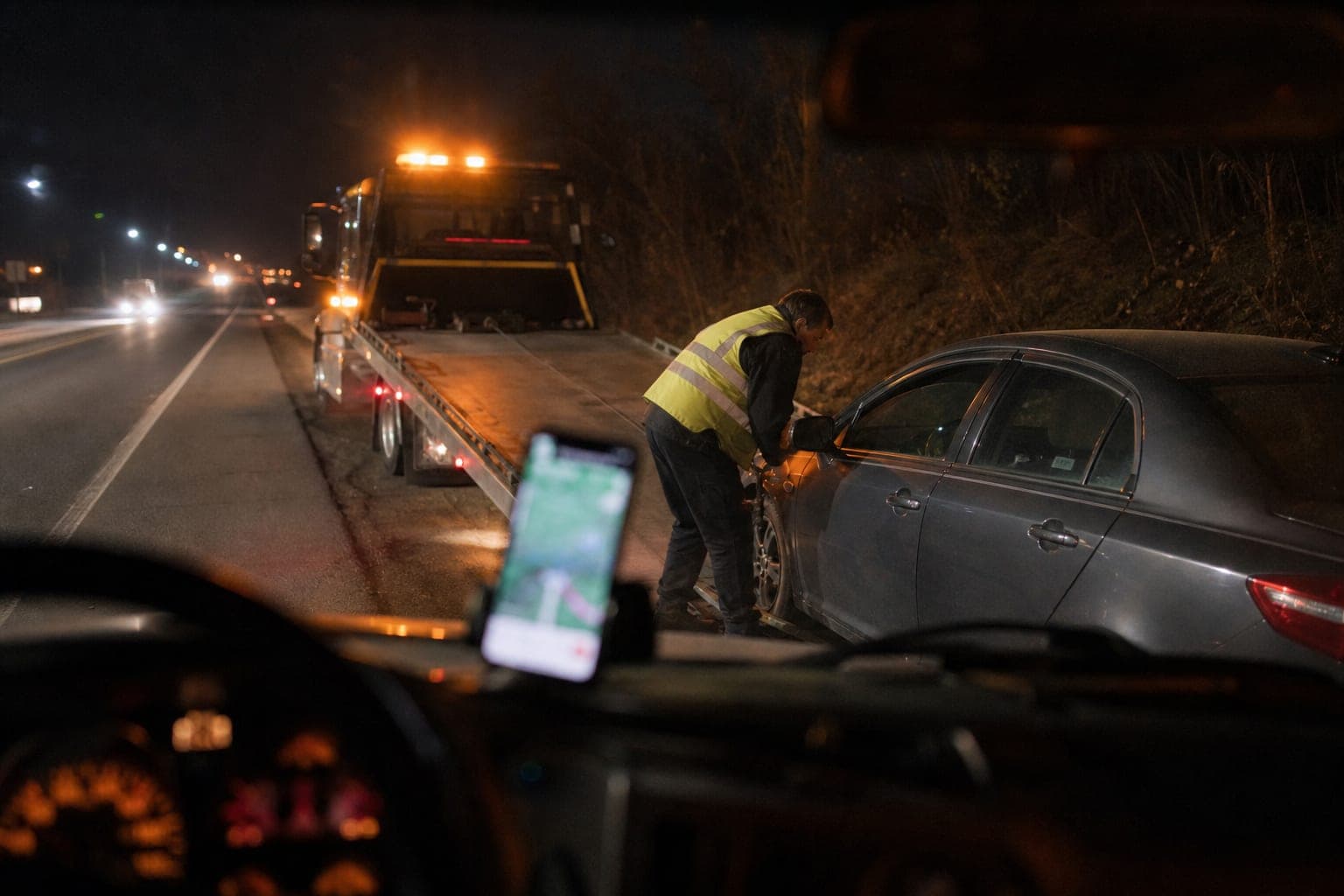
Towing Dispatch Answering Service: Answer Calls While You Hook Up
A towing dispatch answering service captures location, vehicle and drop-off while you are mid-hookup. What it handles, what it can't, and what it costs.

Best Answering Service for Tree Service Companies (2026)
Compare answering services for tree service and arborist businesses. Handle storm damage calls 24/7, book estimates, and capture every lead.

Best Answering Service for Water Damage Restoration Companies (2026)
Compare water damage restoration answering services for 2026: live operators vs 24/7 AI, real pricing, and why speed to answer decides who gets the job.